Ergodicity and the Tales of Two Skiers
Why bets with positive expected value can still ruin you, and why the best short-term strategy isn't the best long-term one.
Published: 2025-12-21 | Last updated: 2026-06-21 by Luca Dellanna
My cousin the skier
My cousin was born in a mountain village in the French Alps. Like many there, he learned to ski before he learned to read. I am a good skier, but I remember the humiliation when I was 14 and he was 6, seeing him surpass me, swift as a bullet. At a young age, he made it into the World Championships for his age bracket. Boy, was he fast! His career ended abruptly a decade later, one leg injury at a time, until he had to retire before his twenties.
From him, I learned that the skiers that you see on TV, the fastest racers in the world, didn’t get there because they were the fastest. They got there because they were the fastest of those who didn’t get injured and forced into retirement. In skiing, and life in general, it is not the best who succeed. It is the best of those who survive.
In theory, performance determines success. The fastest skier wins the race, and the most performing employee becomes the most successful one. In practice, performance is subordinate to survival. It is the fastest racer of those who survive that wins races, it is the highest performing employee who doesn’t burn out that becomes the most successful, and so on. I’m not just making the banal point that survival matters. I’m saying it matters more than performance.
Let’s run the numbers.
Let’s imagine that every time my cousin participates in a skiing race, he has a two-in-ten chance of winning it, and a two-in-ten chance of breaking his knee. How many races will he have won, on average, at the end of a championship consisting of ten races? The naïve answer is two races. That is the product of the number of races, ten, times the probability of winning each, two-in-ten. This would be correct if the race outcomes were independent of each other. However, if he breaks his knee during a race, he misses the following ones. So, he can participate in the second race only if he didn’t injure his legs during the first one. He can participate in the third race only if he didn’t injure his legs in the previous two races, and so on. His chances of completing all ten races are pretty slim, only 11%. If we take the time to compute his chances to participate in each race, we discover that his expected number of wins is less than one. This is fewer than the two wins we would expect if injuries didn’t prevent him from participating in subsequent races.
The point is, in a single instant of time, pure performance is all that matters. Instead, over a prolonged period of time, survival dwarfs performance.
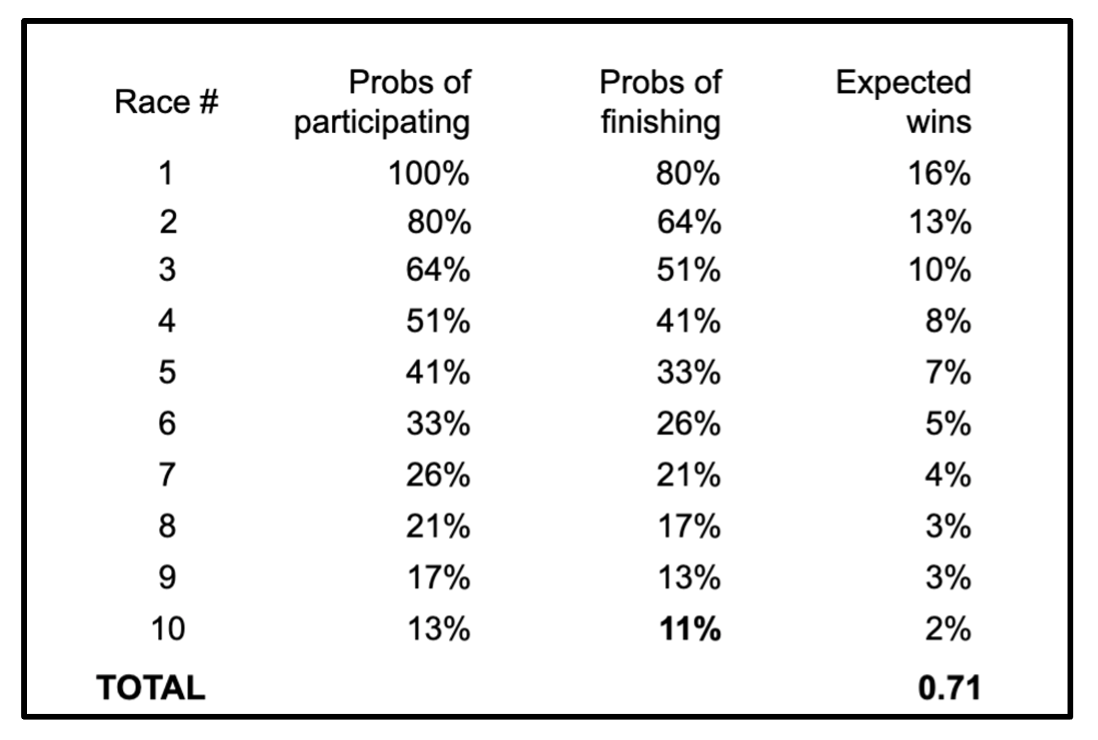
There is a difference between what matters when we consider narrow intervals and what matters when we consider broader ones. Over the short term, consequences that apply beyond the short term do not matter. Over the long term, they do. In my cousin’s case, the broken leg preventing him from competing in future races is a “phantom consequence” that is not observable in the short term but affects the long term. If we make decisions based on what happens over narrow intervals and forget about these “phantom consequences,” we will make bad decisions.
Ergodicity is the study of these phantom consequences.
Ergodicity
What is ergodicity and why does it matter? Learn how irreversible outcomes affect long-term performance in investing, business, and life decisions.

Some reviews
"One of the most important books I've read, period. It's short, articulate, and expansive on a singular subject matter — ergodicity, which is really the key ingredient to success in life, marriage, business, family, happiness, health, etc."

Blake Janover
CEO, Janover Inc.
"One of the most important books for everyone to read. Ergodicity should be taught in school and it should be a common metric in businesses that leaders pay attention to and are deliberate about."

Matt Cannon
"A fascinating book […] Once I started, I couldn't put it down […] the math is minimal, and Luca treats the subject well. I wish I had read it two years earlier"
Robert Matthews
VP of Engineering, Equifax
"One of the very best books I read about risk management. A must read."

Alessandro Francescotto
Partner, Excellence Consulting
"Profoundly insightful [...] If you are someone who often needs to make decisions under uncertainty and using incomplete information (which I think applies to most of us), then Ergodicity is a must-read."

Dev Ashish
StableInvestor Founder
"Brilliant. Must read."

N. S. Ramnath
Journalist & Author
"A brilliant, concise, thought-provoking gem. A must-read for investors."

Rakesh
Investor
"A great book for those who quickly want to familiarize themselves with the concept of ergodicity. The author goes to great lengths explaining the concept in easily understandable terms. Highly recommended!"

Auke Hunneman
BI Norwegian Business School
"Simply brilliant."

Ankit Kanodia
Co-founder, ZenNives
"It helped clarify several longstanding pragmatic questions I had about uncertainty and risk [...] a lucid explanation, accessible for a general audience."

Pankaj Saikia
Datafarer co-founder.
"Excellent book. Highly recommended. Luca compresses a lot of wisdom and actionable guidance into few words. No fluff, no fillers, only thought through foundational ideas."

Eleanor Berger
AI consultant
The tale of two skiers
My cousin’s story shows not only that survival can outweigh raw performance, but also that the right amount of risk depends on how long you intend to play.
Imagine two skiers, Alice and Bob, who enter the same championship with equal skill and fitness, differing only in how much risk they take. Alice is aggressive, so she has a 20% chance of winning each race but a 10% chance of injuring herself. Bob is conservative, so his chance of winning each race is lower, 15%, but his chance of injury is also lower, 1%. Which skier wins the most races?
The counterintuitive answer is that it depends on the length of the championship. As you can see from the table below, Alice’s strategy is better for championships of up to 5 races, whereas Bob’s is better for championships of 6 or more races.
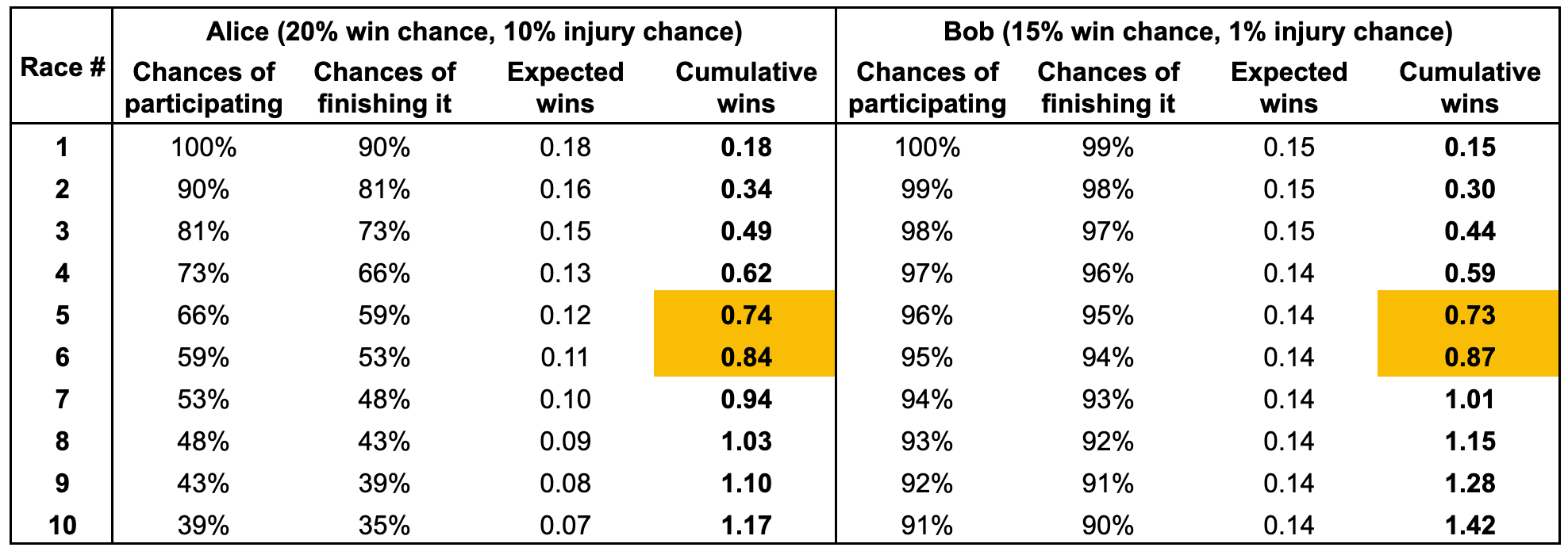
Bob’s edge comes from the fact that every race he avoids injury keeps him in the championship for the next one, and those survival odds compound. Over a long enough horizon, staying in the game beats winning any single race.
Want to experience this yourself? Try my Skiing Ergodicity Game to see how small risks compound over time.
Survivorship bias
In the previous example, we considered one Alice competing against one Bob. But what if, instead, we had 100 Alices competing against 100 Bobs?
In that case, after 10 races, the skier with the most wins is likely to be an Alice. After all, among the 100 Alices, there will likely be at least one who didn’t break her legs. But the Bobs will still have a higher expected number of wins.
This means that the strategy used by the person at the top of the leaderboard is not always the best, and probably not the best strategy for you, especially if you only have one life.
Do not envy success achieved through strategies that are not reproducible.
The Russian Roulette problem
To further understand this phenomenon, let’s consider the gambler’s game of Russian Roulette. The player takes a gun, empties the cylinder, and puts back a single bullet. Then, he spins the cylinder to randomize the position of the bullet. Finally, he takes the gun to his head. After staring at death for a few seconds, he pulls the trigger. If he survives, he collects a prize, usually in the tens of thousands of dollars. (Obviously, do not try this at home, or anywhere else.)
If the prize of winning one round of Russian Roulette is $10,000, its “expected value” is:
(5/6 × $10,000) + (1/6 × $0) = $8,333
What if you play it 10 times? The average outcome is not 10 times the average returns of playing it once, but death.
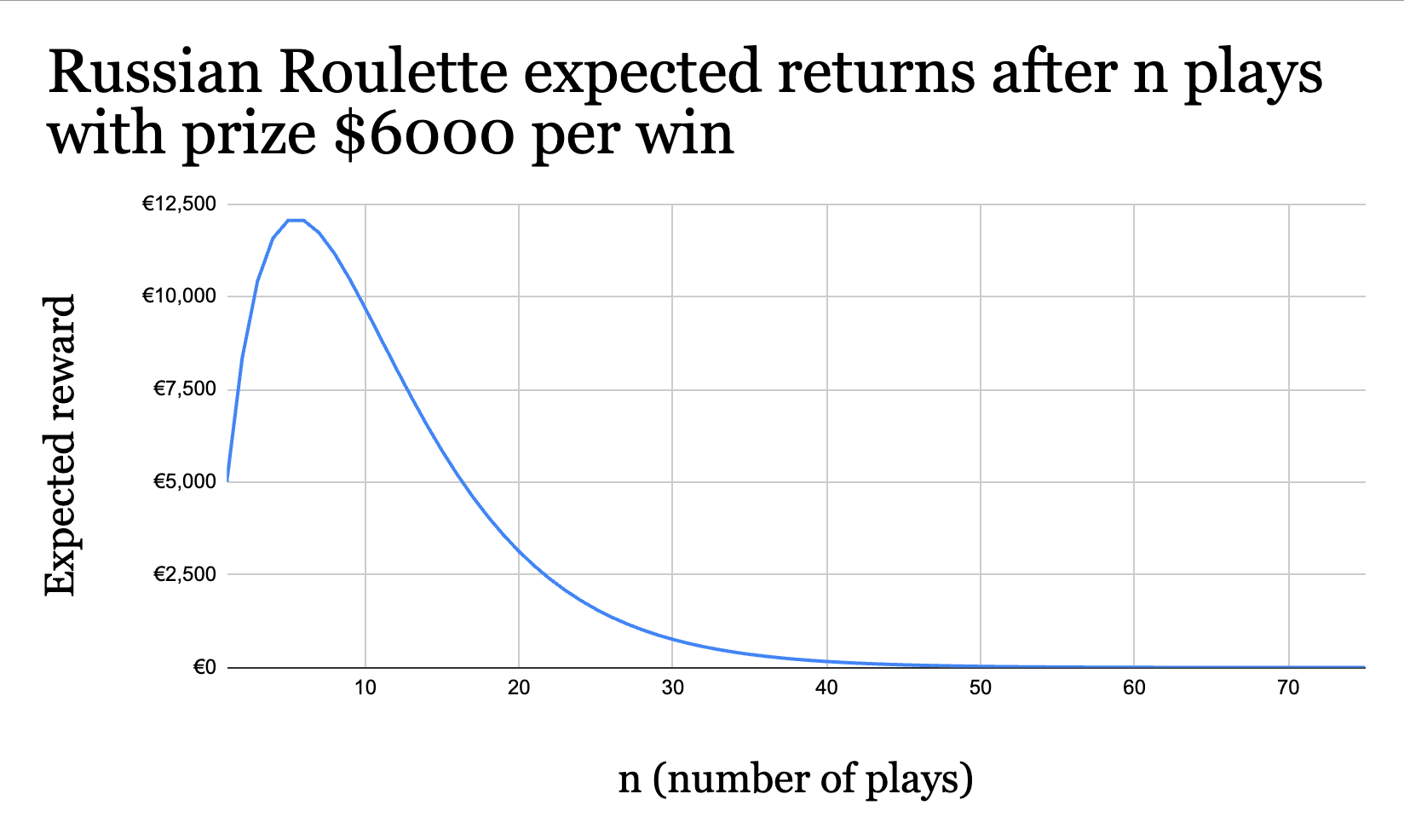
That’s because your probabilities of survival decrease with each round played.
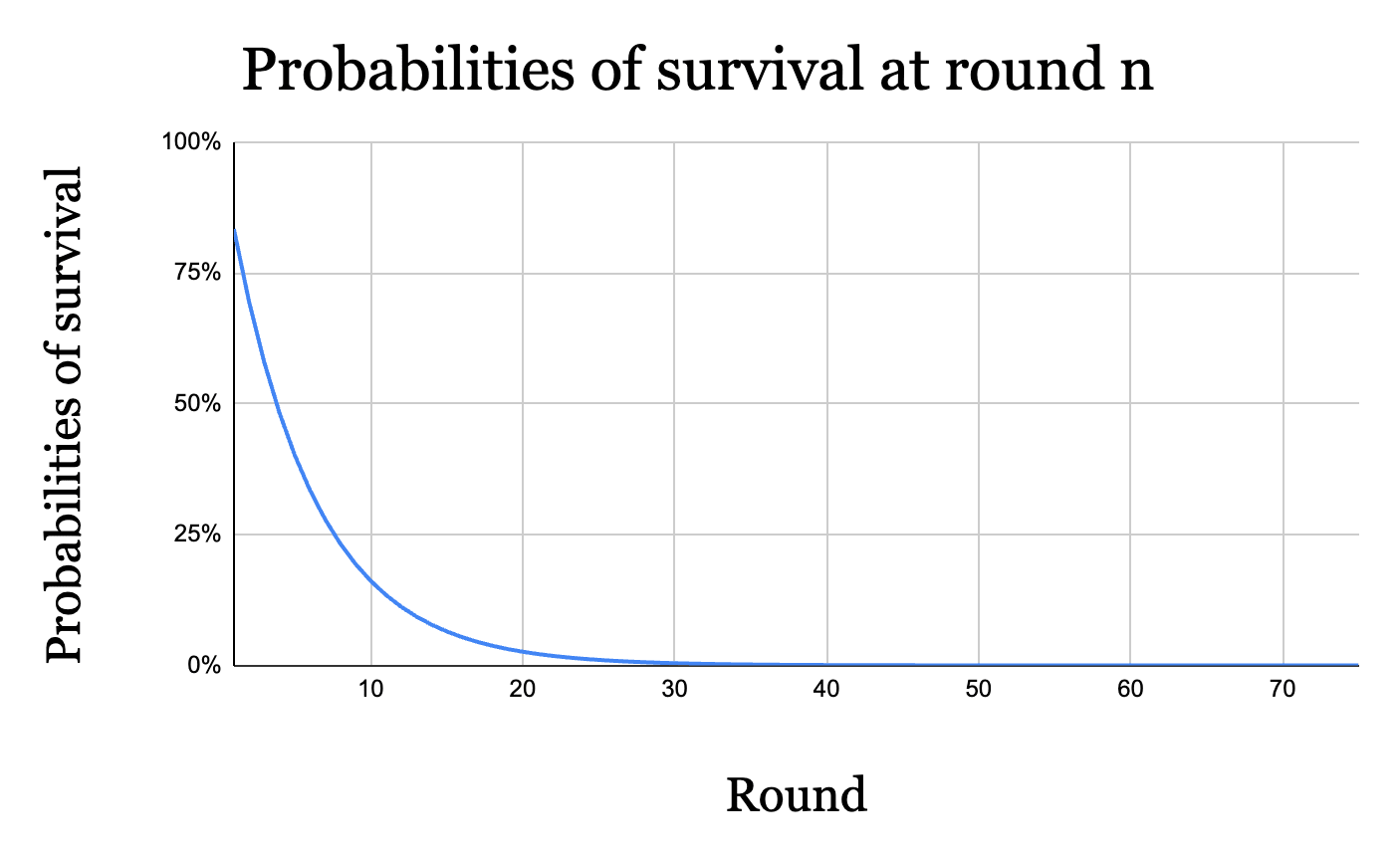
This reveals the fundamental flaw in expected value thinking: it assumes you can somehow experience the average across all possible outcomes. But you only live one life, experiencing one timeline.
In ergodic systems, where losses do not represent game overs, time averages and ensemble averages converge. Instead, in non-ergodic systems, they diverge, often dramatically so.
As the joke goes: “5 in 6 economists think Russian Roulette is a great investment.”The key difference: irreversibility
What makes a system non-ergodic? Irreversibility.
When losses are irreversible, losing a bet doesn’t just mean losing that bet but also all future ones (and thus, missing their returns).
Most important decisions in life are non-ergodic:
- Investing: losing $200 on a $500 investment means losing not just those $200 but also all future returns these $200 could have generated.
- Career: Some behaviors mean you lose not just the current job but all future ones (if they make you unemployable)
- Health: Certain injuries cannot be fully recovered from
- Relationships: Trust, once broken, may never fully recover
Why “risk aversion” is rational
Imagine that you have a sum of $1000 in your pocket, and I offer you to play this game. “You flip a coin. If it’s heads, I give you $1000. If it’s tails, you give me $950. Do you want to participate?”
After one iteration of the game:
- You might have won the toss and won $1000
- You might have lost the toss and lost $950
The average is a win of $25, as expected. However, if you are offered to play a second time, you can only afford to play if you won the first toss. Therefore, you can expect to win $25 from the second toss only if you won the first one.
This means that in four parallel universes:
- In the first, you won both tosses, and you’re up by $2000
- In the second, you won the first toss and lost the second one. You’re up $50
- In the third, you lost the first toss. You’re down $950
- In the fourth, you also lost the first toss and cannot play again. You’re down $950
After two iterations of the game, you have won an average of just:
($2000 + $50 - $950 - $950) / 4 = $37.5
This is surprising! If you had infinite wealth, you would have won an average of $25 per bet times two, which equals $50. But because your wealth is finite, your average win is lower: only $37.5.
More importantly, you have a one-in-four chance of winning a lot of money, a one-in-four chance of winning a modest amount, and a one-in-two chance of having to explain to your spouse why you lost $1,000.
The behavioral economists who called people “irrationally risk-averse” are the irrational ones. Declining a positive expected value bet when you have finite resources isn’t always a bias; often, it’s wisdom.Further readings: Ole Peters’s and Alexander Adamou’s papers discuss this problem and contain additional examples of how (non-)ergodicity explains the hidden rationality of some risk aversion and of other behaviors that would be irrational in an ideal ergodic world. As far as I know, he was the first to propose ergodicity as the solution to many otherwise puzzling behaviors.
Practical implications
For investors
- Don’t bet the shop on “positive expected value” opportunities, but use position sizing that prevents catastrophic losses.
- Do not be envious of those who achieved extreme returns using non-reproducible tactics.
- Diversification is not about sacrificing returns for survival, but about using survival to maximize long-term returns.
For entrepreneurs
- It’s unlikely your first bet will be the one that will make you successful; so, adjust your bet sizing so that you can make enough bets so that at least one will be successful.
For life decisions
- Consider the worst-case scenario, not just the average.
- Distinguish between recoverable and unrecoverable mistakes.
- Instead of optimizing for expected outcomes, optimize for the distribution of possible returns.
The three questions to always ask
Before making any risky decision, ask yourself:
- Can I recover from the worst outcome? If not, the expected value is largely irrelevant, particularly if this is a decision you reckon you’ll have to make more than once.
- Am I envious of non-reproducible success? Just because some succeed doesn’t mean you will.
- Am I optimizing the best possible outcome, or the likely outcome?
Learn more
Understanding the difference between ergodicity and expected value is one of the most valuable mental models for long-term success. If you want to go deeper, read my book on ergodicity.
Risk management is one of my advisory services: I help leaders and investors size their decisions so a single bad outcome can’t take them out of the game.
Frequently Asked Questions
What is ergodicity?
A system is ergodic if the time average (what happens to one person over many repetitions) equals the ensemble average (what happens across many people at once). Most important real-world decisions are non-ergodic because losses are irreversible: a single bad outcome can end the game, meaning your personal result over time diverges sharply from the population average.
What is the difference between expected value and time average?
Expected value is the average outcome across many parallel scenarios simultaneously. Time average is what happens to a single person who repeats the same bet over time. In non-ergodic situations, they diverge: the population average can be positive while the individual trajectory over time is negative, exactly as in the coin flip example, where the ensemble gains while each individual is more likely to lose.
Why is maximizing expected value sometimes the wrong strategy?
Expected value assumes you can somehow experience all possible outcomes at once, but you only live one timeline. When losses are irreversible, a single catastrophic result can remove you from the game entirely, making all future positive outcomes unreachable. For decisions you face repeatedly with finite resources, survival comes first: you cannot benefit from future opportunities you are no longer present for.