





My cousin was born in a mountain village in the French Alps. Like many there, he learned to ski before he learned to read. I am a good skier, but I remember the humiliation when I was 14 and he was 6, seeing him surpass me, swift as a bullet. At a young age, he made it into the World Championships for his age bracket. Boy, was he fast! His career ended abruptly a decade later, one leg injury at a time, until he had to retire before his twenties.
From him, I learned that the skiers you see on TV, the fastest racers in the world, didn't get there because they were the fastest. They got there because they were the fastest of those who didn't get injured and forced into retirement. In skiing, and life in general, it is not the best who succeed. It is the best of those who survive.
Let's run the numbers. Imagine that every time my cousin participates in a race, he has a two-in-ten chance of winning it, and a two-in-ten chance of breaking his knee. How many races would he win, on average, over a ten-race championship? The naïve answer is two: ten races times a two-in-ten chance of winning each. That would be correct if the races were independent of each other. But if he breaks his knee, he misses the races that follow. His chances of completing all ten races are only 11%, and his expected number of wins drops to below one.
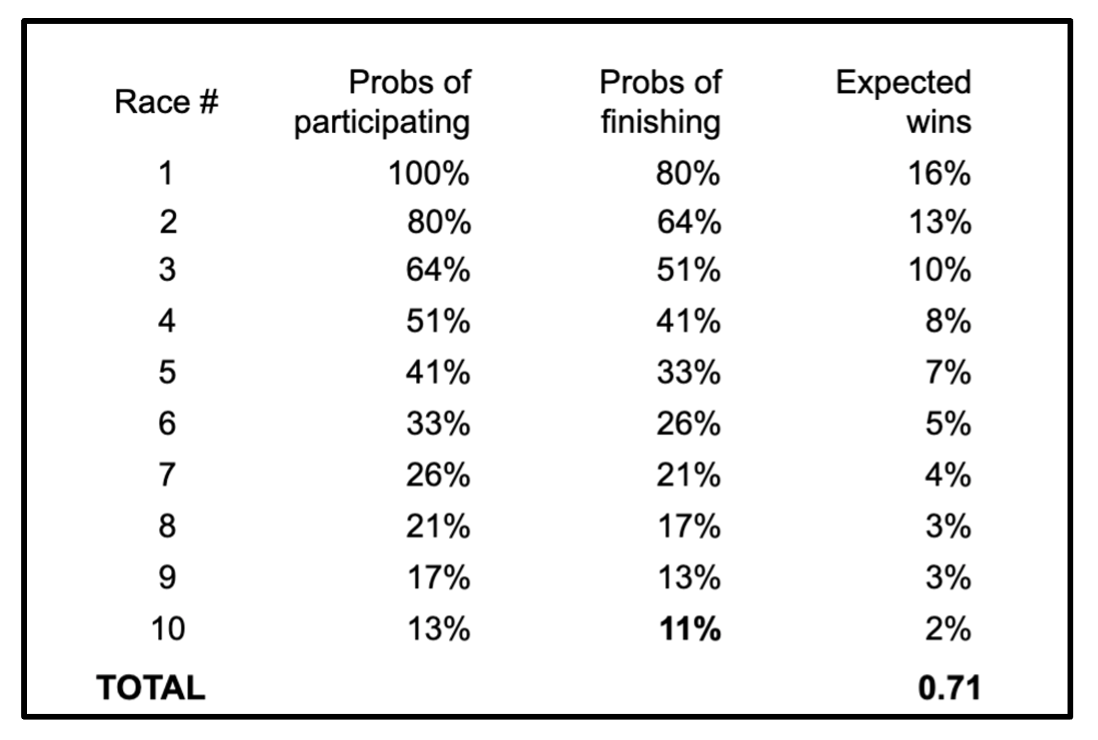
Over a short interval, pure performance is what matters. Over a prolonged period, survival dwarfs performance. My cousin's broken leg preventing him from competing in future races is a “phantom consequence” that isn't observable in the short term but dominates the long term. Ergodicity is the study of these phantom consequences.
Definition
Ergodicity is the study of the effects of irreversibility, and in particular, of how it generates costs that are invisible over a short interval but dominate over a long one. In non-ergodic systems, an irreversible setback doesn't just cost you once, it absorbs every gain you would have made afterward, because it stops you from playing again. Most real-world decisions involving risk, investing, and irreversible outcomes are non-ergodic.
What is Ergodicity Economics?
Ergodicity Economics is a field of study that considers the implications of ergodicity on mainstream economic theory. It challenges fundamental assumptions in economics, finance, and decision theory.
The core insight is simple but profound: most economic models assume ergodicity, but most real-world situations are non-ergodic. This mismatch explains why theoretically optimal strategies often fail in practice.
For example, it shows how you cannot extrapolate averages in the presence of irreversibility, or how long-term investments require different evaluations than short-term ones. You can find a few examples of these phenomena in the excerpt of the first chapter of my book "Ergodicity", which is available for download on my Excerpts page.
Time Averages vs Ensemble Averages
The distinction between time averages and ensemble averages is the heart of ergodicity economics:
- Ensemble average: What happens to many people at a single point in time. “On average, gamblers break even.”
- Time average: What happens to one person over many periods. “This gambler eventually went bankrupt.”
In an ergodic system, these two averages converge. In a non-ergodic system, they diverge - often dramatically.
The Tale of Two Skiers
Imagine two cousins, Alice and Bob, who decide to participate in a skiing championship. They have the same skill level, but with one difference: Alice takes more risks, so she has a 20% chance of winning each race and a 10% chance of injuring herself. Bob is more conservative: 15% chance of winning, but only 1% chance of injury.
Which skier wins the most races?
The counterintuitive answer is that it depends on the length of the championship. Alice's strategy is better for championships of up to 5 races, whereas Bob's is better for championships of 6 or more races.
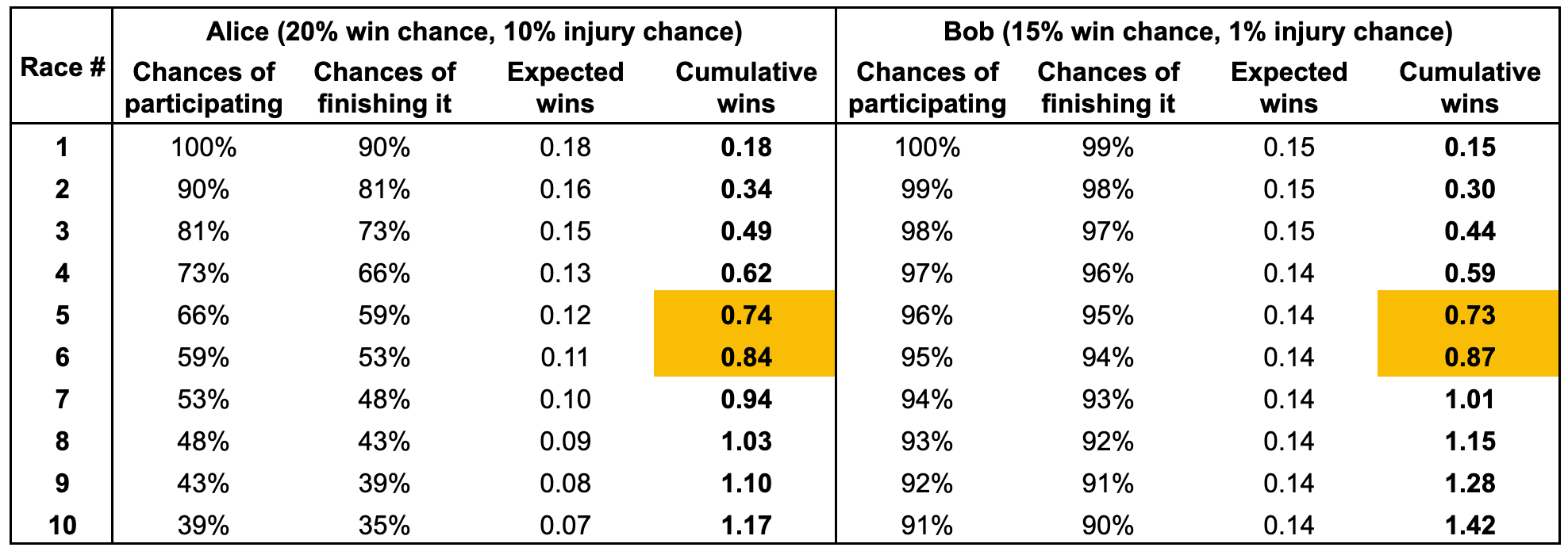
The strategy that produces the best short-term results is not always the strategy that produces the best long-term returns.
Don't Imitate Winners
What if we compared 100 Alices vs. 100 Bobs? The racer with the most wins after 10 races would likely be an Alice, even though on average, Bobs have more wins. The winner's strategy is not always the best strategy. Careful who you decide to imitate.
Want to experience this yourself? Try the Skiing Ergodicity Game or the Russian Roulette Game to feel how small risks compound over time.
The Russian Roulette Problem
To further understand this phenomenon, consider the gambler's game of Russian Roulette. The player empties a gun's cylinder, puts back a single bullet, spins the cylinder, and pulls the trigger. If they survive, they collect a prize, usually in the tens of thousands of dollars. (Obviously, do not try this at home, or anywhere else.)
If the prize for winning one round is $10,000, its expected value is:
(5/6 × $10,000) + (1/6 × $0) = $8,333
What if you play it 10 times? The average outcome is not 10 times the average return of playing it once, but death.
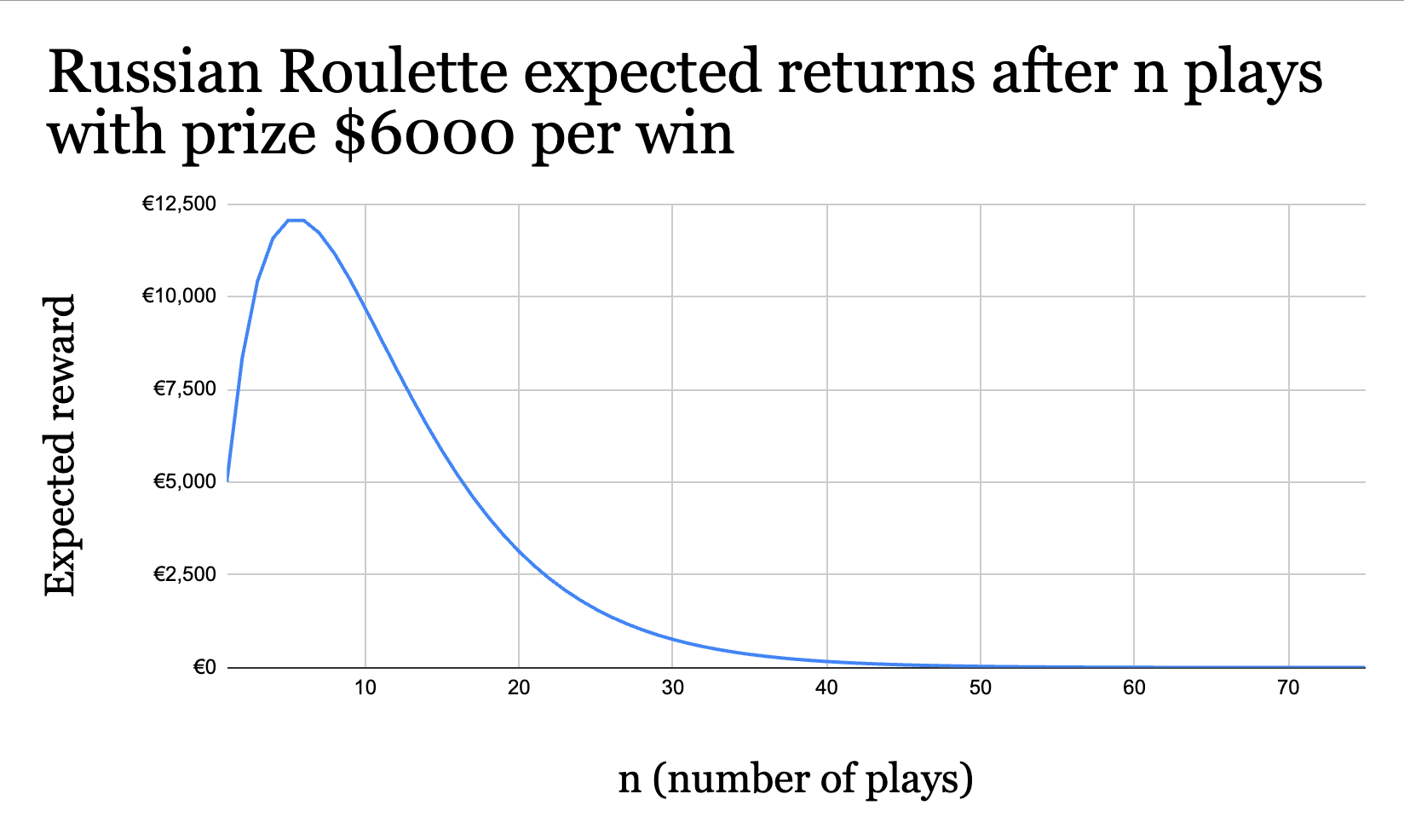
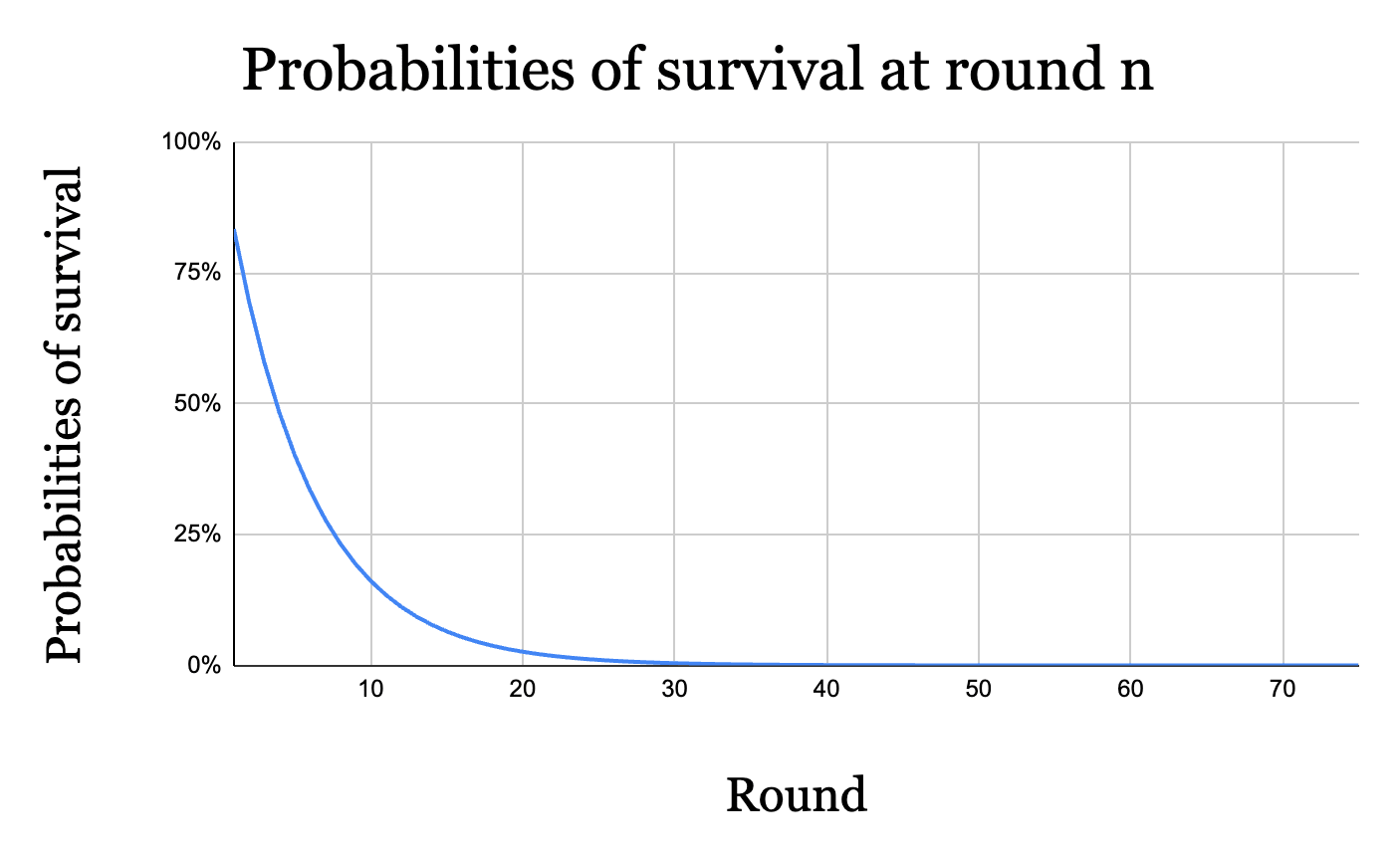
That's because your probability of survival decreases with each round played. In ergodic systems, where losses don't represent game overs, time averages and ensemble averages converge. In non-ergodic systems, they diverge, often dramatically so.
As the joke goes: “5 in 6 economists think Russian Roulette is a great investment.”
Why Ergodicity Matters
Understanding ergodicity transforms how you approach decisions involving risk and uncertainty:
- Expected value can mislead: A bet with positive expected value can still ruin you if outcomes are irreversible.
- Survival trumps optimization: You must stay in the game long enough for averages to matter.
- Time horizon changes everything: The same strategy can be optimal or disastrous depending on how long you play.
Why “Risk Aversion” Is Rational
There is a common belief that people are irrationally risk averse. Consider this game: flip a coin. Heads, you win $1000. Tails, you lose $950. The expected value is +$25 per flip. Yet most people decline. Behavioral economists call this “irrational.”
But real people don't have infinite cash. If you start with $1000 and lose the first flip, you can't play again. Your limitation on the number of times you can play transforms your lifetime outcome.
After two iterations: you have a one-in-four chance of being up $2000, one-in-four of being up $50, and one-in-two chance of being down $950. The behavioral economists who called people “irrationally risk-averse” are the irrational ones.
Further readings: Ole Peters's and Alexander Adamou's papers discuss this problem and contain additional examples of how (non-)ergodicity explains the hidden rationality of some risk aversion and of other behaviors that would be irrational in an ideal ergodic world. As far as I know, he was the first to propose ergodicity as the solution to many otherwise puzzling behaviors.
The Key Difference: Irreversibility
What makes a system non-ergodic? Irreversibility. When losses are irreversible, losing a bet doesn't just mean losing that bet, but also all the future ones it would have let you make.
Most important decisions in life are non-ergodic:
- Investing: losing $200 of a $500 investment means losing not just those $200, but also all the future returns those $200 could have generated.
- Career: some behaviors cost you not just the current job, but every future one, if they make you unemployable.
- Health: certain injuries cannot be fully recovered from.
- Relationships: trust, once broken, may never fully recover.
The question to ask before any risky decision isn't “what's the expected outcome?” but “can I recover from the worst outcome?” If not, the expected value calculation is largely irrelevant.
Real-World Applications
Ergodicity has profound implications across many domains:
Investing
Warren Buffett's first rule of investing is “never lose money.” His second rule? “Never forget rule number one.” Understanding ergodicity reveals why this is one of the most profound insights in investment strategy: a 50% loss requires a 100% gain to recover, a 90% loss requires a 900% gain, and at -100%, no amount of future gains can help you. This asymmetry means survival trumps performance. Diversification and position sizing aren't about sacrificing returns for safety, but about using survival to maximize long-term returns. The Kelly Criterion offers a mathematically rigorous approach to position sizing in non-ergodic markets.
Insurance
Insurance looks irrational by expected-value math: on average, you pay more in premiums than you receive in claims. But insurance converts a rare, catastrophic, non-ergodic loss into a small, predictable, ergodic cost, which is why buying it is rational even at a price above fair value. See Ergodicity and Insurance for the full breakdown, including when it makes sense to skip it.
Career Decisions
Some career moves are reversible (changing companies, trying a new role) while others are harder to undo (burning bridges, reputation damage, industry blacklisting). Ergodicity helps identify which risks are worth taking. See Ergodicity in Career Decisions for the full framework, including a table showing how small repeated risks compound over a 40-year career.
Business Strategy
Why startups should focus on survival before growth, and why “move fast and break things” works for some decisions but not others. It's unlikely your first bet will be the one that makes you successful, so size your bets to make enough attempts that at least one can succeed.
Health
Certain health risks are non-ergodic: you cannot "average out" a fatal accident or permanent injury. This explains the asymmetry between prevention and treatment.
Relationships
Trust is non-ergodic: easier to destroy than to build. Understanding this changes how you approach commitments and conflicts.
Try It Yourself: Interactive Games
Experience ergodicity firsthand with these interactive simulations:
- Skiing Game - See how small daily risks compound over a lifetime
- Russian Roulette Game - Watch expected value diverge from actual outcomes
Three Questions to Ask Before Any Risky Decision
- Can I recover from the worst outcome? If not, the expected value is largely irrelevant, particularly for a decision you'll have to make more than once.
- Am I envious of non-reproducible success? Just because some succeed with a strategy doesn't mean you will.
- Am I optimizing the best possible outcome, or the likely outcome?
Risk management is one of my advisory services: I help leaders and investors size their decisions so a single bad outcome can't take them out of the game.
Key Researchers in Ergodicity Economics
Ole Peters is perhaps the researcher who has advanced the most Ergodicity Economics. Namely, he and Alexander Adamou wrote the seminal paper Ergodicity Economics, which inspired my book "Ergodicity" (in fact, the reason I wrote it is that I loved the aforementioned paper but thought it was written in an excessively technical and abstract way, which restricted the audience, and instead I wanted to help laypeople understand this extremely useful idea of ergodicity and its many applications without having to understand the mathematics behind it).
Nassim Nicholas Taleb is the scholar through which I got to know about ergodicity, as he briefly mentions it in his book Skin In The Game.
Other scholars who worked on the topic include Murray Gell-Mann, Ed Thorp, John Larry Kelly Jr., Harry Crane, and Joseph Norman.
Further Reading
My Articles on Ergodicity
- Ergodicity and Insurance - Why “bad bets” make sense
- Ergodicity in Career Decisions - Which professional risks are worth taking
- Ergodicity as a Non-Binary Property - Why ergodicity exists on a spectrum
Books on Ergodicity
- Ergodicity by Luca Dellanna - A practical guide focusing on applications rather than theory
- "Skin in The Game" and "Antifragile" by Nassim Nicholas Taleb - Popular introductions to related concepts
Academic Papers
- "Ergodicity Economics" by Ole Peters and Alexander Adamou - The technical reference paper
- "Ergodicity as a Non-Binary Property" - My research on degrees of non-ergodicity
- "The Dynamics of Ergodicity" - Second-order effects in risk-taking
Media Appearances
I have discussed ergodicity on several podcasts including EconTalk with Russ Roberts, Infinite Loops with Jim O'Shaughnessy, and many others. See my full list of podcast appearances.