The Pareto Frontier
The one definition of "optimal" that doesn't lead to races to the bottom.
Published: 2026-08-19 by Luca Dellanna
Every time I participate in a high school reunion, I have a choice in how I compare myself to others. One option is to notice that, among my former classmates, there is at least one who earns more than I do, at least one who has more free time than I do, and so on. Another option is to notice that, among my former classmates who earn at least as much as I do, I’m the one with the most free time. And among those who have at least as much free time as I do, I’m the one who earns the most.
Learning to view success through this lens is highly beneficial. For example, do you want to be as successful as possible, or do you want to be as successful as possible while always having dinner with your family? Then, you shouldn’t compare yourself with anyone who does not also spend all their dinners with their family.
Never compare yourself with someone who has different priorities or is optimizing for different objectives or for a shorter time horizon. Doing so leads to unhappiness and/or making counterproductive decisions.
The Pareto Frontier
Just now, I presented two ways to compare yourself to others.
- “There is someone who earns more than I do and someone with more free time than I do.”
- “Among those who earn as much as I do, I have the most free time, and among those with as much free time as I do, I earn the most.”
The second type of evaluation is called the Pareto Frontier, named after the Italian mathematician Vilfredo Pareto (the same one who invented the Pareto Rule, also called the “80/20 rule”: 20% of your customers are responsible for 80% of your problems, and so on). In particular, I am on the Pareto Frontier if, given two metrics, A and B, among everyone who has at least as much A as I do, I have the most B, and among everyone who has at least as much B as I do, I have the most A.
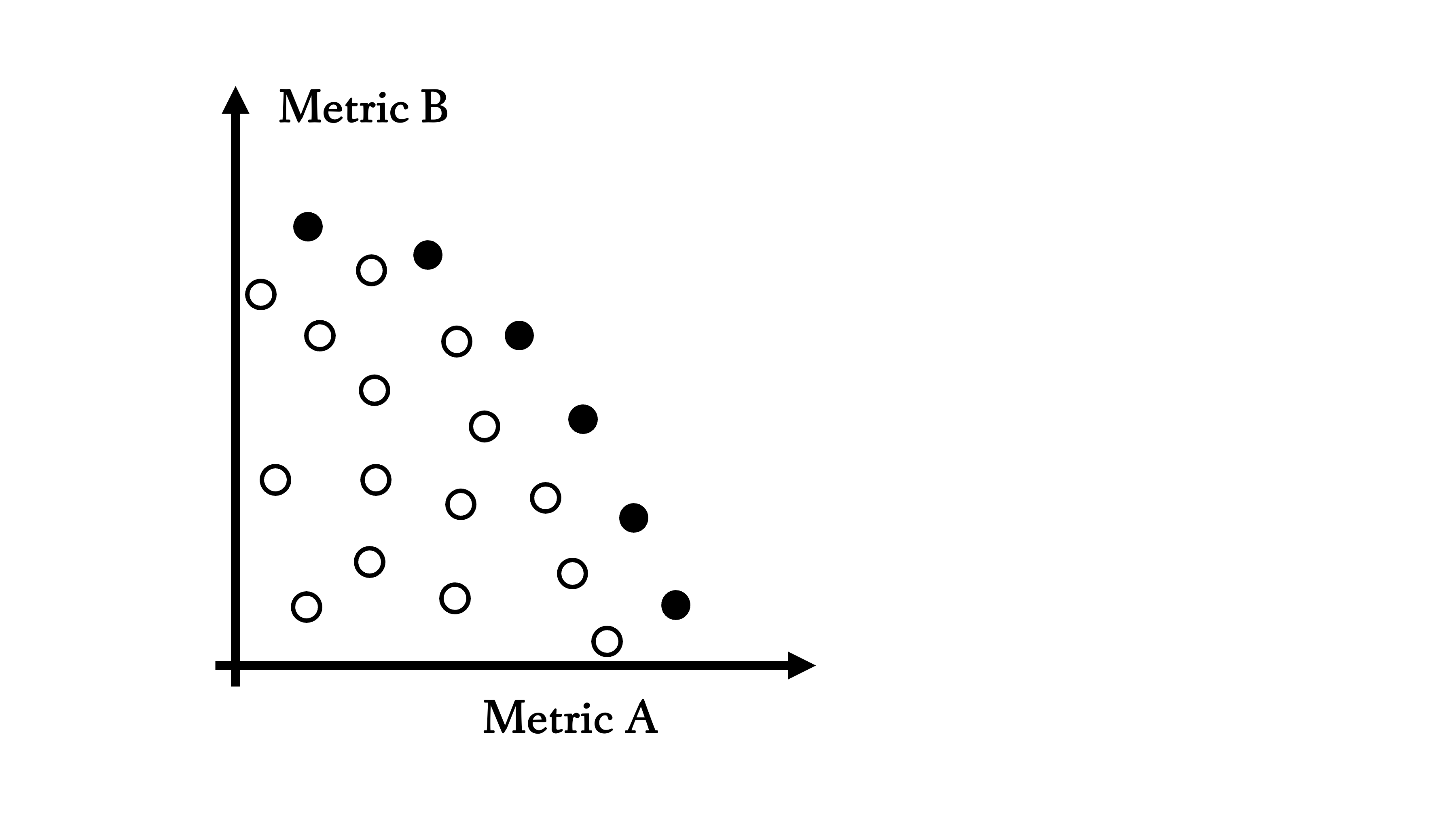
The Pareto Frontier is also useful for comparing options. For example, without knowing about the Pareto Frontier, you might compare jobs by asking yourself which one is the highest paying. Instead, by using the Pareto Frontier, you might ask yourself better questions, such as, what’s the highest-paying job among those that enable you to spend enough time with your family?
The Pareto Frontier isn’t a revolutionary concept; many of us already make decisions using a similar mental process. However, giving it a name and making it explicit is useful because it shows that choosing a job that’s not the highest paying is not necessarily a lazy or suboptimal choice. If it’s on the Pareto Frontier of what matters to you, it is an ambitious and optimal choice.
How the Pareto Frontier helps you win long-term games
Single-metric comparisons such as “who earns more” are toxic because they lead to feelings of inferiority and/or races to the bottom. Conversely, comparing yourself to others using multi-metric comparisons such as the Pareto Frontier is a relatively healthy way to assess whether you’re being ambitious enough. If you are at the Pareto Frontier in the areas that matter to you, you’re probably doing fine (as long as being there isn’t the result of short-term optimization). Conversely, if you are far from your Pareto Frontier, you might have been too lazy or conservative.
But perhaps more importantly, defining success in terms of Pareto frontiers helps you avoid the temptation to follow those who take excessive risks or make sacrifices you’re not willing to take.
Instead of aiming to be the most successful, aim to be the most successful among those who play long-term games and are not willing to take excessive risks or make excessive sacrifices. Your distribution of outcomes will improve.
This is an excerpt from my book Winning Long-Term Games.