Policy Lab: AI Agents for Policy
AI agents that design better policy proposals, representing real voting blocs, surfacing genuine disagreements, and negotiating trade-offs.
Published: 2026-03-05 by Luca Dellanna
I’ve recently published a research project, Policy Lab, that uses AI agents to design better policy while keeping the electorate at the center. Let me explain.
The problem
Our current policy-making system, in theory, is great: voters elect representatives who then gather in a congress or parliament and draft laws while negotiating trade-offs. But in practice, voters elect incompetent professional politicians who then talk over each other’s heads, performing to fire up their constituents rather than to produce effective laws. So, we get policies that are poorly designed, poorly communicated, and then quickly overturned when the balance of power shifts.
Why we’re stuck
It’s easy to say we should elect more competent politicians, or that we should discuss policy more constructively. But let’s be honest: this won’t happen as long as most proposals on the table are poor. A proposal that ignores half the country doesn’t invite discussion, only retaliation. The result is more polarization, more tribal language, and less policy quality. Moreover, politicians have weak incentives to serve citizens as a whole: it’s often more rewarding to energize the most vocal voters, or the wealthiest donors, the people who help you win the next election.
So, I thought: as long as we discuss poor policies, the discussion will be poor. But what if we could start from a draft that already handles the real disagreements in the electorate?
The solution
My Policy Lab project is precisely this: an attempt to generate a first reform draft designed for a fragmented electorate, where disagreements are surfaced and negotiated rather than hidden under the carpet.
The goal is not to replace human politicians or to auto-pass laws; it’s to upgrade the starting point so that the next conversation (among voters, journalists, staffers, and politicians) begins from something less polarizing and more serious.
AI can help, but not in the naive way. Asking a general-purpose AI to “draft an immigration bill” produces a generic draft, not something designed to hold up under real-world constraints and trade-offs. Policy Lab provides that structure.
The methodology
Given a topic and a country (for example, “Immigration in the US”), Policy Lab runs a structured debate among AI agents.
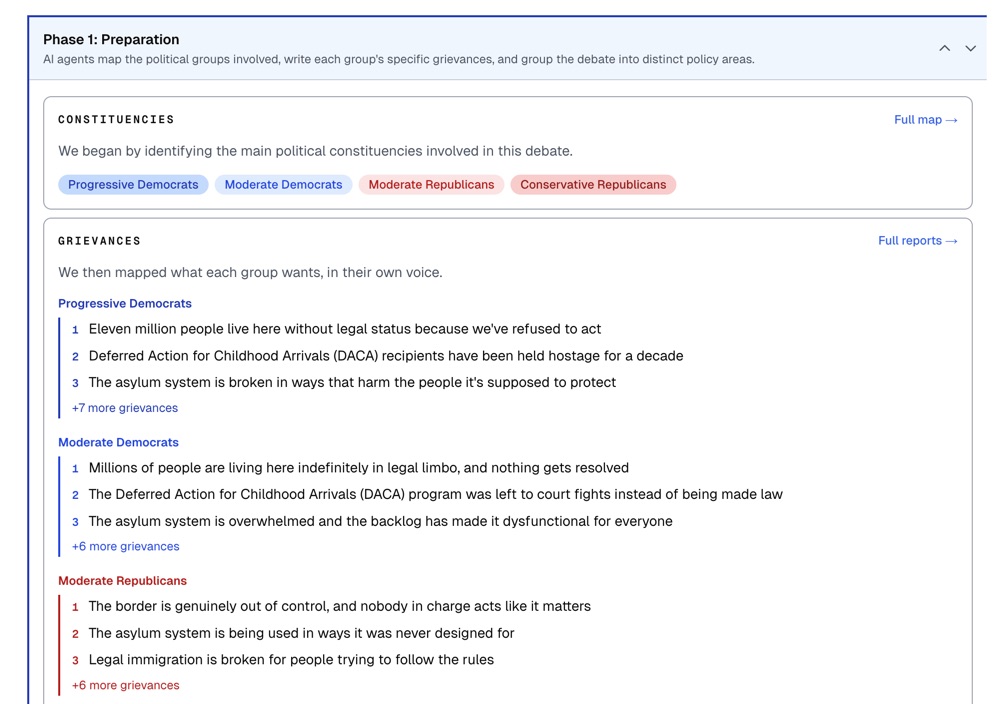
First, it creates agents that represent major voting blocs (for example, Progressive Democrats, Moderate Democrats, Moderate Republicans, and Conservative Republicans). Each agent lists its group’s grievances with the current policy, in the language that group actually uses: what feels unfair, what feels broken, what trade-offs they refuse, what outcomes they care about.
Then an “Independent Analyst” agent synthesizes those grievances, runs root-cause analysis, and researches the legislative status quo and constraints.
Afterward, an “Independent Legislator” agent drafts a bill. That draft goes back to the constituency agents, who critique it, propose changes, and negotiate trade-offs. The loop repeats across multiple rounds until every bloc agrees on a specific claim: the draft is a meaningful improvement over the status quo, even if it’s not their ideal world.
Of course, the actual process is more complex than this summary. To give you an idea, it takes about two hours for the AI to run. I tried more efficient processes, but they were producing worse results. It turns out that, to produce good outputs, you truly need to invest in having a multitude of agents, each representing different parties, negotiating and providing feedback to each other.
A key factor is that the voter-group agents are instructed to genuinely fight for the values, beliefs, and self-interest of the real-life voters they represent, but to do so in good faith and collaboratively.
The result is high-quality policy proposals.
They are not “ready to pass,” and they are not an argument to remove humans from politics. But they are a better starting point: a proposal that has already been forced to confront a fragmented electorate and to negotiate its trade-offs explicitly.
Starting from a bill produced with this methodology can lead to more constructive discussion by human politicians and voters alike, and ultimately to better laws.
Try it!
Visit luca-dellanna.com/policy-lab to see the draft bills the system produced. At the moment of writing, the project includes “Immigration Reform in the US,” “Healthcare Reform in the US,” and “Immigration Reform in Italy,” but I will add more soon.
If you have ideas or suggestions, or you’d like to see the system’s output on a topic you have at heart, let me know.